
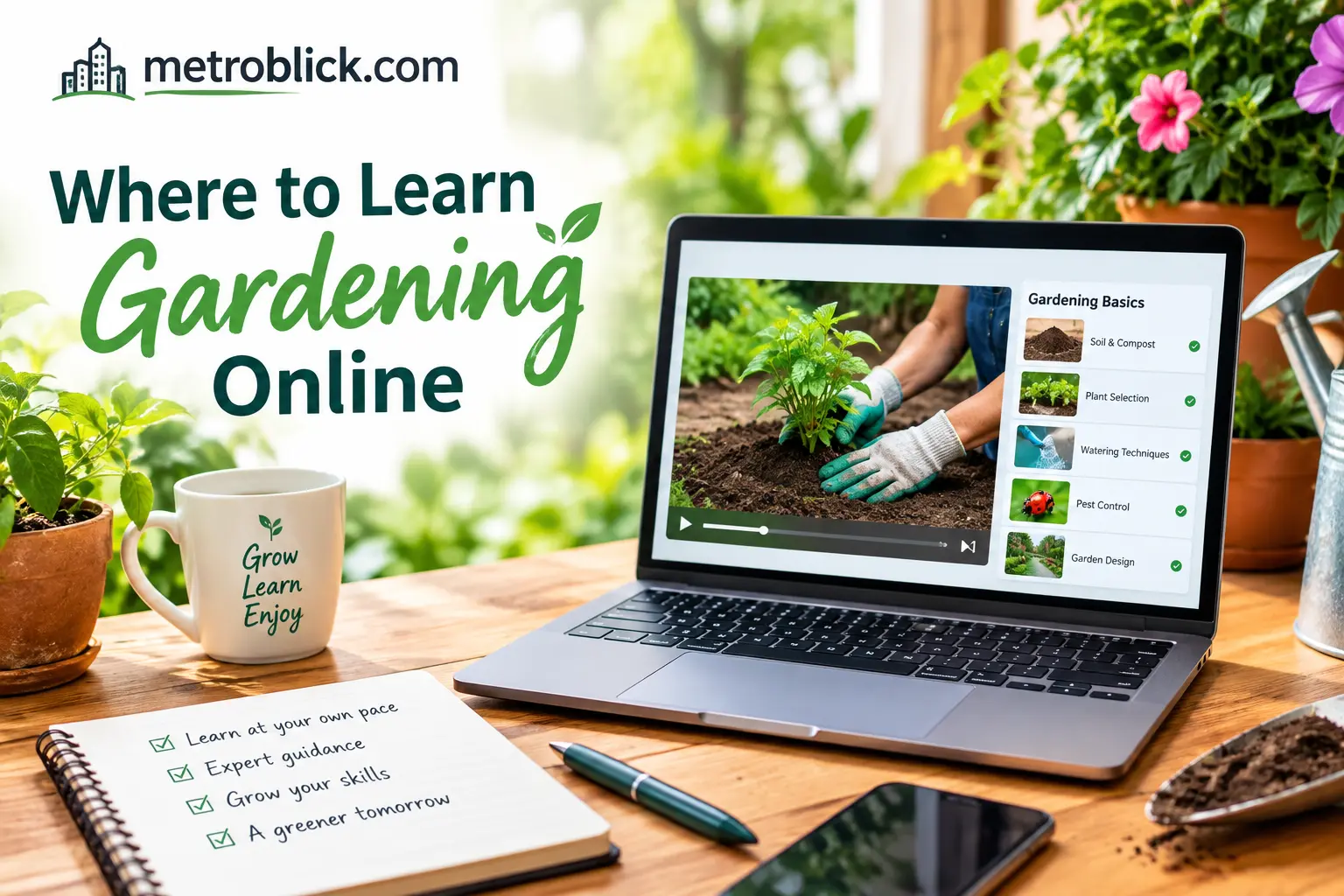
If you want to grow vegetables, care for houseplants, design a garden, or simply understand how plants grow, where to learn gardening online is one of the first questions worth answering. The good news is that you no longer need to attend a local class to build solid gardening knowledge. Online gardening courses, university extension programs, video tutorials, plant databases, gardening communities, and interactive learning platforms now cover everything from basic plant care to advanced horticulture.
Knowing where to learn gardening online is only the beginning. The right learning path depends on your experience, available space, climate, budget, and gardening goals. A beginner with a balcony needs different lessons from someone planning a vegetable garden, while a person interested in horticulture as a career may need structured academic training.
This guide explains the major ways to learn gardening online in 2026, what each option teaches, how to choose reliable information, and how to turn online lessons into practical gardening skills.
Where to Learn Gardening Online in 2026
There are several useful places to learn gardening online, and each serves a different purpose.
Online gardening courses are useful when you want a structured curriculum. They can take you from soil and plant selection to propagation, pest management, and garden design.
University extension programs are particularly valuable when you want science-based gardening information. Extension services often publish material specific to regional climates, plants, insects, diseases, and soil conditions. Current programs include fully online and hybrid learning options from university extension systems.
Video tutorials are useful for seeing practical techniques such as sowing seeds, transplanting seedlings, pruning, taking cuttings, building raised beds, and preparing compost.
Online horticulture courses go deeper into plant science and can be appropriate for learners who want professional or academic knowledge.
Gardening websites and plant databases are helpful for looking up individual plants, growing requirements, pests, diseases, and seasonal tasks.
Online communities can help when you encounter a practical problem and want to compare experiences from other gardeners.
The best approach is often not to choose just one format. A structured course can provide the foundation, while videos, reference resources, and hands-on practice can fill in practical details.
Why Learn Gardening Online?
Learning gardening online offers flexibility that traditional classes cannot always provide. You can study in the evening, pause a video while working in the garden, revisit a lesson before planting, and choose subjects that match your interests.
It can also be more convenient for people who live far from gardening clubs, botanical gardens, horticultural schools, or local instructors.
Another major advantage is the variety of subjects available. A single learning platform may offer lessons on:
- Soil science
- Plant nutrition
- Vegetable gardening
- Flower gardening
- Houseplants
- Container gardening
- Composting
- Organic gardening
- Garden design
- Plant propagation
- Pest management
- Sustainable gardening
- Horticulture
- Landscaping
Online learning also makes it easier to compare different teaching approaches. You might learn soil preparation from a university extension lesson, watch a video demonstrating seed starting, and then use a plant database to check the growing requirements of a particular species.
Where to Learn Gardening Online for Beginners
Complete beginners should start with resources that explain fundamental concepts rather than jumping straight into advanced horticulture.
A good beginner gardening course should explain how plants depend on sunlight, water, air, nutrients, soil, temperature, and space. It should also explain why two plants can require completely different growing conditions.
Look for beginner lessons covering:
- Plant anatomy
- Basic soil types
- Sunlight requirements
- Watering
- Seeds and seedlings
- Transplanting
- Fertilization
- Basic pruning
- Common pests
- Plant diseases
- Seasonal gardening
- Harvesting
You do not need to memorize botanical terminology before starting. Learn the basic concepts first and introduce technical terms as they become useful.
What should a beginner learn first?
Start with plant needs and local growing conditions. Once you understand sunlight, temperature, water, soil, and plant selection, many other gardening decisions become easier.
For example, if a plant repeatedly struggles in a shaded area, learning another fertilizer technique may not solve the problem. The real issue may simply be insufficient light.
Free Gardening Resources and Courses
Free gardening resources can provide a surprisingly strong foundation. They are especially useful if you are unsure whether you want to commit money to a formal course.
Free resources commonly include:
- University extension articles
- Gardening videos
- Plant databases
- Public webinars
- Gardening newsletters
- Digital gardening guides
- Online community discussions
- Demonstration videos
- Public horticulture lectures
Some course directories currently list hundreds of gardening-related courses across subjects such as plant care, vegetable gardening, composting, indoor gardening, garden planning, and sustainable gardening.
The important distinction is that free does not automatically mean reliable, and paid does not automatically mean high quality.
When using free gardening information, check who created it, whether the information is supported by horticultural research, whether it identifies the relevant climate or region, and whether the material has been updated.
Online Gardening Courses and Classes
Online gardening classes range from short introductory lessons to multi-week programs.
A short course might teach one specific skill, such as container gardening or composting. A longer program may cover plant biology, soil, garden planning, plant selection, pest management, and seasonal maintenance.
Current online offerings demonstrate how broad the field has become. Platforms and educational providers offer beginner gardening, plant growth, healthy plants, indoor gardening, urban nature, ecological gardening, and horticulture subjects.
Before enrolling, check:
- Course length
- Skill level
- Curriculum
- Instructor background
- Practical assignments
- Student support
- Reviews
- Certificate details
- Access period
- Course update date
- Whether lessons apply to your climate
What makes an online gardening class useful?
The strongest classes connect theory with action. For example, instead of simply explaining soil pH, a useful course may show how soil pH affects nutrient availability and then explain how a gardener can interpret a soil test.
That connection between what happens, why it happens, and what to do about it is particularly valuable for beginners.
University Extension Gardening Programs
University extension services are among the most useful sources for research-based gardening education.
Extension programs translate university research into practical information for gardeners, farmers, homeowners, and communities. Many offer online courses, articles, plant resources, diagnostic information, workshops, and gardening guides.
For example, NC State Extension’s current online Gardens, Lawns and Landscapes program includes subjects such as soil and plant fundamentals, edible plants, pest and disease management, landscape materials and design, and lawn management.
Other extension programs use a combination of self-paced lessons, live sessions, quizzes, practical assignments, and local hands-on activities.
Why are university extension resources useful?
They often provide regional information rather than generic advice.
A gardening recommendation that works in a cool, wet climate may not work in a hot, dry environment. Extension resources can help you understand local growing seasons, plant selection, pests, diseases, and environmental conditions.
Gardening YouTube Channels and Video Tutorials
Video is particularly effective for gardening because many techniques are easier to understand when you can see them.
A written explanation of pruning can tell you what to cut, but a clear demonstration can show where the cut is made and what the finished plant should look like.
YouTube and other video platforms can help with:
- Seed starting
- Propagation
- Repotting
- Pruning
- Composting
- Raised-bed construction
- Vegetable gardening
- Container gardening
- Indoor plant care
- Garden design
- Pest identification
However, not every gardening video is equally reliable.
Look for creators who explain why they recommend a technique rather than simply saying that something works. Be cautious when a video presents one person’s experience as a universal rule.
Best Online Horticulture Courses
Gardening and horticulture overlap, but horticulture is broader and more scientific.
Horticulture includes the cultivation, management, propagation, identification, and use of plants. Depending on the program, you may study plant biology, soil science, plant nutrition, plant identification, irrigation, pest management, landscape design, propagation, and environmental conditions.
Current university programs show the depth available online. UCLA Extension, for example, offers horticulture education covering plant biology, soil health, plant identification, plant care, irrigation, propagation, indoor plants, and landscape design, with some courses available online.
Cornell also offers distance-learning horticulture courses designed around practical, hands-on activities for gardeners and professionals.
If your goal is simply to maintain a backyard garden, a full horticulture program may be more than you need. If you want deeper plant knowledge or professional preparation, however, horticulture courses can provide a stronger foundation.
What You Can Learn From an Online Gardening Course
A comprehensive online gardening course can cover the complete plant-growing process.
You can learn how seeds germinate, how roots absorb water and nutrients, how plants respond to light, why soil structure matters, how plants are propagated, and how environmental stress affects growth.
Common subjects include:
- Soil preparation
- Soil fertility
- Compost
- Seeds
- Germination
- Seedlings
- Transplanting
- Plant nutrition
- Irrigation
- Mulching
- Weed management
- Pruning
- Propagation
- Pollination
- Pest management
- Disease diagnosis
- Harvesting
- Garden planning
- Sustainable gardening
Some advanced programs also cover plant taxonomy, landscape plants, irrigation design, horticultural business, arboriculture, and ecological gardening.
Gardening Basics Every Beginner Should Learn
Before worrying about advanced techniques, understand the five basic environmental factors that influence most plants:
Light: Plants differ in how much direct or indirect sunlight they need.
Water: Too little water can cause wilting and stress, while excessive moisture can reduce oxygen around roots and contribute to root problems.
Soil: Soil provides physical support, water, air, and nutrients. Texture, drainage, organic matter, and pH can all matter.
Temperature: Plants have different temperature ranges in which they grow well.
Nutrition: Plants need essential nutrients, but more fertilizer is not necessarily better.
Plant selection should come after understanding these conditions. Instead of asking only, “What plant looks good?”, ask, “Will this plant thrive in the conditions I can provide?”
How to Choose the Right Online Gardening Course
Start with your goal.
If you want to grow tomatoes and herbs, choose a course focused on vegetable gardening. If you want healthy houseplants, look for indoor gardening and plant-care lessons. If you want a career in horticulture, look for a more comprehensive academic or professional program.
Then evaluate the curriculum.
A useful course should clearly explain what you will learn instead of relying on vague promises such as “become an expert gardener quickly.”
Also consider whether the course includes practical work. Gardening is a hands-on skill, so a program that asks you to observe plants, conduct simple experiments, plan a garden, or complete practical tasks can be more useful than one consisting entirely of passive videos.
Free vs. Paid Gardening Courses
Free and paid resources serve different purposes.
| Feature | Free Resources | Paid Courses |
|---|---|---|
| Cost | Usually free | Usually requires payment |
| Structure | Varies | Often structured |
| Subject depth | Basic to advanced | Often more systematic |
| Instructor support | Limited or unavailable | May be included |
| Certificates | Uncommon | May be available |
| Flexibility | Usually high | Depends on provider |
| Best use | Exploring and reference | Structured learning |
A free university resource may be more useful than an expensive course from an inexperienced instructor. Evaluate the quality and relevance of the education, not simply the price.
Self-Paced vs. Instructor-Led Gardening Classes
Self-paced courses let you study when convenient. They are useful for people with unpredictable schedules and for learners who prefer to repeat difficult lessons.
Instructor-led courses provide deadlines, scheduled sessions, feedback, and opportunities to ask questions.
A self-paced program can work particularly well for basic gardening knowledge. Instructor support may become more valuable when studying complex subjects such as horticultural design, plant pathology, soil science, or professional horticulture.
Some modern programs combine both approaches. For example, CSU Extension’s Colorado Green School includes self-paced online lessons alongside live online review sessions with subject-matter experts.
Online Gardening Courses for Different Skill Levels
Beginner gardeners
Start with plant needs, soil, sunlight, watering, planting, basic pest identification, and seasonal care.
Intermediate gardeners
Move into propagation, soil improvement, crop rotation, pruning, integrated pest management, composting, garden design, and more detailed plant selection.
Advanced gardeners
Explore plant taxonomy, plant physiology, landscape design, soil science, irrigation, ecological gardening, propagation, pest management, and professional horticulture.
Your skill level should be based on what you can understand and apply, not how many gardening videos you have watched.
Where to Learn Vegetable Gardening Online
Vegetable gardening requires more than knowing how to plant a seed.
A good vegetable gardening course should cover:
- Seed selection
- Direct sowing
- Seed starting
- Transplanting
- Soil preparation
- Crop spacing
- Sunlight
- Watering
- Fertilization
- Mulching
- Pest management
- Disease prevention
- Harvest timing
- Succession planting
- Seasonal planning
Beginners can start with relatively straightforward crops suited to their climate and available space.
The most important lesson is to match the crop to the growing conditions. A vegetable that performs well in one region may struggle elsewhere because of heat, cold, humidity, day length, soil conditions, or pest pressure.
Where to Learn Organic Gardening Online
Organic gardening focuses on managing a garden using approaches that emphasize soil health, ecological relationships, biological processes, and responsible inputs.
A strong organic gardening course should explain:
- Compost
- Organic matter
- Soil biology
- Mulching
- Crop rotation
- Companion planting
- Beneficial insects
- Integrated pest management
- Organic fertilizers
- Weed management
- Sustainable soil practices
Organic does not mean that every natural substance is automatically safe or appropriate. Good education explains how an input works, when it is needed, and how to use it responsibly.
Cornell’s current online organic gardening course, for example, emphasizes soil health and a whole-system approach to growing annuals, perennials, food plants, and ornamentals.
Where to Learn Container Gardening Online
Container gardening is ideal for balconies, patios, windowsills, rooftops, and other areas without traditional garden beds.
Online container gardening lessons should cover:
- Choosing containers
- Drainage
- Potting mix
- Container size
- Plant selection
- Watering
- Fertilization
- Root space
- Light exposure
- Repotting
Container plants often dry out faster than plants growing in the ground, so watering needs can differ significantly.
A useful course should teach you how to observe the plant and growing medium rather than giving one watering schedule that supposedly works everywhere.
Where to Learn Indoor Gardening Online
Indoor gardening includes houseplants, herbs, seedlings, microgreens, and other plants grown inside controlled environments.
Important topics include:
- Indoor light
- Artificial grow lights
- Humidity
- Temperature
- Air circulation
- Potting mixes
- Drainage
- Watering
- Fertilization
- Pest prevention
- Repotting
Indoor conditions can be very different from outdoor conditions. A plant that receives bright outdoor sunlight may struggle indoors because glass, room orientation, distance from windows, and seasonal changes alter available light.
Where to Learn Urban Gardening Online
Urban gardening makes use of limited spaces such as balconies, rooftops, patios, community gardens, windowsills, and small yards.
Online urban gardening courses can teach:
- Vertical gardening
- Container gardening
- Raised beds
- Small-space crop selection
- Balcony gardening
- Rooftop gardening
- Composting in limited spaces
- Water-efficient gardening
Urban gardening also requires attention to building rules, structural limits, water access, sunlight, wind exposure, and container weight where relevant.
Where to Learn Sustainable Gardening Online
Sustainable gardening aims to create productive and attractive gardens while using resources responsibly and supporting healthy ecosystems.
Important subjects include:
- Water conservation
- Native plants
- Soil health
- Composting
- Pollinator gardens
- Habitat creation
- Reduced chemical use
- Rainwater management
- Mulching
- Biodiversity
- Integrated pest management
Sustainable gardening is not one fixed technique. The most suitable approach depends on local climate, soil, water availability, plants, and environmental conditions.
Where to Learn Garden Design Online
Garden design combines horticultural knowledge with visual planning.
A garden design course may teach:
- Site assessment
- Garden layout
- Plant selection
- Color
- Texture
- Scale
- Balance
- Pathways
- Focal points
- Seasonal interest
- Hardscape
- Irrigation planning
Cornell’s current online garden design education includes site assessment, design principles, plant selection, personal aesthetics, and development of a rough site plan.
A beginner can start with a simple drawing showing the garden’s boundaries, sunlight, existing plants, paths, water access, and desired planting areas.
Where to Learn Horticulture Online
Horticulture is the deeper study of cultivated plants and their management.
If you want to learn horticulture online, look for courses in:
- Botany
- Plant physiology
- Plant identification
- Soil science
- Plant nutrition
- Plant propagation
- Irrigation
- Pest management
- Plant pathology
- Landscape horticulture
- Arboriculture
- Sustainable horticulture
Professional programs can be substantially more demanding than hobby gardening classes. Some include certificates or structured programs, while others are non-credit continuing education.
Cornell specifically distinguishes its online horticulture courses as non-accredited courses for adult learners, while other institutions offer certificate programs.
How to Learn Gardening for Your Local Climate
Gardening advice should never be separated completely from climate.
Before choosing plants or following a planting schedule, find out:
- Your general climate
- Your local temperature range
- Your growing season
- Your soil characteristics
- Your sunlight exposure
- Typical rainfall
- Local pest pressure
- Frost or extreme-heat patterns where relevant
Hardiness zones can help with temperature-related plant selection, but they do not describe every factor affecting gardening. Humidity, rainfall, soil, heat, wind, elevation, and seasonal timing can also influence plant performance.
For example, a plant may survive winter temperatures in a particular region but still perform poorly because the summer climate, soil moisture, or humidity is unsuitable.
Stay updated with the latest insights, fresh stories, and amazing new articles roll off dumpster.
How to Find Gardening Resources for Your Location
Start with your country’s agricultural universities, horticultural organizations, botanical gardens, government agriculture departments, and university extension services.
Search for combinations such as:
- Your city + gardening guide
- Your region + vegetable planting calendar
- Your country + horticulture extension
- Your climate + gardening
- Your region + native plants
- Your area + soil testing
- Your region + plant disease diagnosis
Local resources are particularly valuable for pest identification, planting times, native plants, soil conditions, and climate-specific recommendations.
For example, current university programs can be highly location-specific. Colorado State University’s gardening education explicitly focuses on Colorado’s soils, climate, insects, wildlife, and plants.
How to Practice Gardening While Learning Online
Watching lessons is not enough.
The fastest way to turn gardening knowledge into useful skill is to practice while you study.
Start with a small project. Grow a few herbs in containers, start a small vegetable bed, care for several houseplants, or propagate an easy plant.
Keep a simple gardening journal containing:
- Plant name
- Planting date
- Location
- Sun exposure
- Watering
- Fertilizer
- Weather conditions
- Growth observations
- Pest or disease symptoms
- Harvest date
Take photographs at regular intervals. This creates your own visual record and helps you identify patterns that are difficult to remember.
Can You Learn Gardening Completely Online?
You can learn a large amount of gardening theory online, including plant biology, soil management, garden design, plant selection, pest management, propagation, and seasonal planning.
However, practical gardening experience cannot be completely replaced by a screen.
Real gardens behave differently from examples in courses because soil, weather, sunlight, pests, water, plant genetics, and microclimates vary.
The most effective model is online learning plus real-world practice.
Can You Learn Gardening Without Having a Garden?
Yes.
You can begin with houseplants, containers, seed-starting projects, herbs, microgreens, or even observation exercises.
You can also practice garden planning digitally or on paper before you have outdoor space.
A balcony, windowsill, patio, or small container can provide enough space to learn many fundamental concepts.
The important thing is to choose plants appropriate for the space and light you actually have.
Is YouTube Enough to Learn Gardening?
YouTube can teach a great deal, particularly practical techniques.
It is excellent for watching someone demonstrate:
- How to transplant seedlings
- How to prune
- How to make compost
- How to propagate plants
- How to build a raised bed
- How to repot a plant
- How to harvest vegetables
The limitation is structure.
A playlist may teach individual techniques without giving you a complete understanding of plant biology, soil, climate, nutrition, pest management, and seasonal planning.
For that reason, YouTube works particularly well as a practical supplement to structured gardening education.
Are Online Gardening Courses Worth It?
They can be worthwhile when they solve a specific learning problem.
A paid course is more likely to provide value when it has:
- A clear curriculum
- Qualified instructors
- Practical assignments
- Current information
- Useful demonstrations
- Feedback or community support
- A subject that matches your goals
Do not pay simply because a course uses words such as “master,” “expert,” or “professional.”
Read the curriculum before enrolling and compare it with free research-based resources.
How Long Does It Take to Learn Gardening?
There is no universal finish line for gardening.
A beginner can understand basic concepts relatively quickly, but becoming confident takes repeated practice across different plants and growing conditions.
Think of gardening knowledge in stages:
First stage: Understand plant needs.
Second stage: Successfully grow a few plants.
Third stage: Diagnose common problems.
Fourth stage: Plan around seasons and local conditions.
Fifth stage: Experiment, adapt, and develop your own gardening system.
Even experienced gardeners continue learning because weather, pests, plants, and growing environments constantly change.
How AI Can Help You Learn Gardening Online
AI can act as a learning assistant when used carefully.
You can ask an AI system to:
- Explain horticultural terms in simple language
- Build a beginner study plan
- Create a seasonal gardening checklist
- Compare plants
- Turn a gardening lesson into notes
- Generate questions for self-testing
- Explain soil concepts
- Organize a planting plan
- Suggest questions to investigate when a plant looks unhealthy
AI can also help personalize learning. Instead of asking for a generic vegetable gardening guide, you can provide information about your available space, sunlight, climate, and experience and ask for a learning sequence.
But AI should not automatically be treated as the final authority.
Plant problems can have multiple causes, and incorrect identification can lead to unnecessary pruning, fertilization, pesticide use, or plant removal.
Using AI for Plant Identification and Garden Troubleshooting
Image-based AI and visual search can help you investigate an unfamiliar plant or symptom.
For example, you might photograph:
- A leaf with spots
- Yellowing leaves
- An unusual insect
- A flower
- A weed
- A seedling
- A damaged stem
The result should be treated as a starting point, not a guaranteed diagnosis.
A good troubleshooting process is:
- Photograph the entire plant.
- Photograph the affected area closely.
- Record when the problem started.
- Note recent changes in watering, fertilizer, temperature, or location.
- Check the underside of leaves for insects or eggs.
- Compare the symptoms with reliable horticultural references.
- Consider more than one possible cause.
- Take action only when the evidence supports it.
This is especially important for plant diseases and pesticide decisions.
How Google AI Overviews and AI Mode Change Gardening Search
Modern search increasingly answers questions directly rather than requiring users to open several traditional results.
Google’s AI Overviews and AI Mode can synthesize information from multiple web sources, which means a gardening article needs to provide clear, useful answers and strong supporting context rather than simply repeating keywords. Google’s documentation notes that generative search features use web sources and remain connected to normal crawling and indexing considerations.
For gardening publishers, this means writing content that answers specific questions clearly:
- What does this plant need?
- Why are its leaves turning yellow?
- When should I plant it?
- How much sunlight does it need?
- What soil is appropriate?
- How can I identify this pest?
- What should a beginner learn first?
Use descriptive headings, concise explanations, logical topic relationships, original information, and trustworthy references.
Do not create separate pages simply by changing a city or plant name. Location-specific content should provide genuinely different information.
How to Evaluate Gardening Information Found Online
Before trusting gardening advice, ask:
Who published it?
Look for universities, extension services, horticultural organizations, experienced educators, qualified professionals, or authors who clearly demonstrate relevant knowledge.
What evidence supports it?
Be cautious of absolute claims such as “this always works” or “every gardener should do this.”
Does it account for climate?
Advice without location or environmental context may not apply to your garden.
Is it current?
Gardening principles remain stable in many areas, but products, regulations, technology, climate information, and recommended practices can change.
Does the author explain why?
An explanation of the mechanism behind a recommendation is often more useful than a simple instruction.
How to Find Reliable and Research-Based Gardening Advice
University extension services, agricultural universities, botanical gardens, government agriculture departments, horticultural organizations, and established educational institutions can be strong starting points.
Research-based does not mean every recommendation is identical. Gardening involves local conditions, different plant varieties, different climates, and different management systems.
Compare sources when advice conflicts.
For example, if one source recommends watering every two days and another recommends watering weekly, the real answer may depend on soil type, container size, temperature, rainfall, plant species, and root development.
Current extension education demonstrates the value of combining research-based material with practical learning. UConn Extension describes its programs as research-backed and includes online courses and hands-on learning opportunities.
Common Mistakes When Learning Gardening Online
One common mistake is copying another gardener’s exact schedule.
A watering schedule that works in one garden may fail in another.
Another mistake is learning techniques without understanding plant needs. A gardener may learn how to fertilize but not recognize that poor light is causing slow growth.
Other common problems include:
- Overwatering
- Excessive fertilization
- Ignoring drainage
- Choosing plants unsuitable for the climate
- Ignoring sunlight requirements
- Treating every yellow leaf as a nutrient deficiency
- Using pesticides before identifying the pest
- Following outdated information
- Trusting a single source
- Watching tutorials without practicing
- Buying advanced courses before understanding the basics
The solution is to connect every technique with the underlying reason.
How to Build a Personalized Online Gardening Learning Plan
A personalized plan can be simple.
Step 1: Define your goal
Decide whether you want vegetables, flowers, houseplants, containers, organic gardening, garden design, horticulture, or general gardening knowledge.
Step 2: Assess your space
Record the available sunlight, soil, containers, water access, and approximate growing area.
Step 3: Identify your climate
Find reliable local information about temperature, growing seasons, rainfall, and common gardening conditions.
Step 4: Choose foundational lessons
Start with plant biology, soil, sunlight, watering, plant selection, and basic maintenance.
Step 5: Choose one practical project
Do not try to grow twenty different plants immediately. Start small.
Step 6: Document the results
Photographs and notes will help you understand what worked and what failed.
Step 7: Study problems as they occur
If leaves turn yellow, use that event as a learning opportunity. Investigate possible causes rather than immediately applying a product.
Step 8: Expand gradually
Once the basics are comfortable, move into propagation, composting, pruning, garden design, pest management, and specialized gardening.
This approach turns random online searches into a structured gardening education.
Best Gardening Resources for Soil, Plants, and Pest Management
For soil, focus on soil texture, drainage, organic matter, pH, nutrients, soil testing, and biological activity.
For plants, learn identification, sunlight requirements, temperature tolerance, mature size, water needs, growth habit, and seasonal behavior.
For pests, learn identification before treatment. Determine whether the organism is actually damaging the plant and whether it is a pest, beneficial insect, or harmless visitor.
For diseases, look at symptoms, affected plant parts, environmental conditions, and disease progression.
For plant nutrition, understand that nutrient deficiency symptoms can resemble symptoms caused by root problems, water stress, pests, disease, or unsuitable soil conditions.
A strong gardening education teaches you how to investigate these differences instead of giving you a single universal treatment.
How to Use Visual Search to Identify Plants and Gardening Problems
Visual search is becoming increasingly important for gardening because plants and symptoms are inherently visual.
Google announced web Search Console reporting for multimodal searches in September 2026. The reporting includes searches involving Google Lens, Circle to Search, image uploads, and image-based searches, reflecting the growing role of visual discovery in Search.
For gardeners, this creates useful possibilities.
You can use an image to investigate:
- Plant identification
- Leaf damage
- Insects
- Flowers
- Weeds
- Garden layouts
- Plant diseases
- Soil-related visual problems
When taking a photograph for identification, include both a full-plant image and close-up images. Add information such as location, season, sunlight, watering routine, and when the symptoms appeared.
For gardening websites, original photographs and useful visual explanations can also provide additional ways for content to be discovered through image and multimodal search.
FAQs
Where can beginners learn gardening online?
Beginners can use structured online gardening courses, university extension programs, gardening videos, plant databases, and practical beginner guides. Start with plant needs, soil, sunlight, watering, planting, and basic pest management.
Can I learn gardening online for free?
Yes. Free university extension resources, gardening videos, public educational material, plant databases, and community resources can teach many fundamental gardening skills without requiring a paid course.
What should I learn first in gardening?
Start with sunlight, water, soil, temperature, plant selection, planting, and basic plant care. Understanding these fundamentals makes more advanced gardening techniques easier to understand.
Can I learn gardening without a backyard?
Yes. Containers, balconies, patios, windowsills, indoor plants, herbs, and small raised beds can provide practical gardening experience.
Are online gardening courses worth it?
They can be useful when the curriculum, instructor expertise, practical work, and subject match your goals. Compare the course with reputable free resources before paying.
Is YouTube enough to learn gardening?
YouTube is excellent for demonstrations, but a structured course or research-based reference source can provide a more complete foundation.
How long does it take to learn gardening?
Basic concepts can be learned relatively quickly, but practical gardening knowledge develops through repeated experience across different plants, seasons, and growing conditions.
What is the difference between gardening and horticulture?
Gardening generally refers to growing and maintaining plants for personal or practical purposes. Horticulture is the broader scientific and professional field covering cultivated plants, their production, management, propagation, identification, and related practices.
How can I learn gardening for my local climate?
Use regional university extension programs, agricultural universities, botanical gardens, government agriculture resources, local planting calendars, and climate-specific gardening courses. Then choose plants according to your actual conditions.
Can AI identify a plant from a photo?
AI and visual-search tools can help identify plants and investigate symptoms, but results should be verified with reliable horticultural resources, especially before taking action against a disease or pest.
Can AI diagnose plant diseases?
AI can help generate possible explanations from images and descriptions, but visual symptoms often overlap between diseases, pests, nutrient problems, and environmental stress. Verification is important before treatment.
Do online gardening courses provide certificates?
Some do, but the type of certificate varies. A certificate of completion is not necessarily the same as a professional qualification, academic credential, or certification recognized by an organization.
Can I learn horticulture completely online?
Some horticulture theory and continuing education can be completed online, and certain programs are fully online. However, hands-on experience is valuable for developing practical horticultural skills. Current university programs vary from non-credit online courses to online certificate pathways.
What is the best way to practice gardening while taking an online course?
Choose a small real-world project and keep a journal. Record planting dates, watering, sunlight, weather, growth, pests, diseases, and results. This turns lessons into practical knowledge.
Conclusion
Online gardening education in 2026 is much broader than watching a few planting videos. Beginners can build a strong foundation through free resources, structured gardening courses, university extension programs, horticulture education, practical tutorials, and real-world experimentation.
The most useful learning path starts with the basics: understand your environment, learn what plants need, choose suitable species, practice on a manageable scale, and record what happens. From there, you can move into vegetable gardening, organic gardening, container gardening, indoor plants, sustainable gardening, garden design, pest management, propagation, or professional horticulture.
AI and visual search can make learning more interactive, but they work best as supporting tools rather than replacements for reliable horticultural knowledge and hands-on experience. The goal is not simply to collect gardening information. It is to understand why plants behave the way they do, apply that knowledge in your own growing environment, and improve with every season.
Stay updated with the latest insights, fresh stories, and amazing new articles Burger King Careers.



One thought on “Where to Learn Gardening Online in 2026: Courses & Free Resources”