
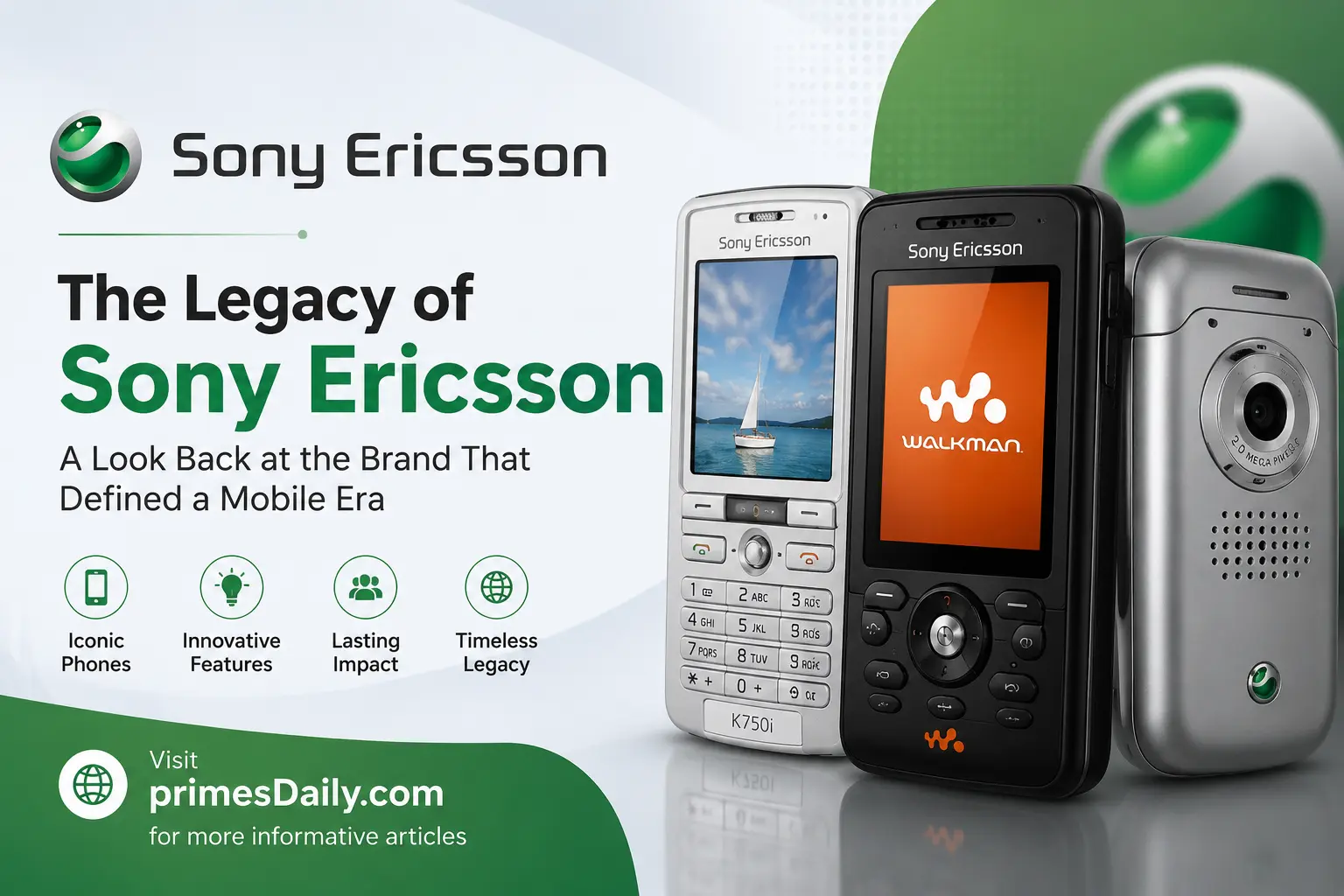
The mobile-phone industry changed dramatically during the years when Sony and Ericsson worked together. Their joint venture created devices that were not simply communication tools; many were designed around music, photography, games, messaging and distinctive physical design. That approach helped create some of the most memorable handsets of the pre-iPhone and early smartphone era.
Today, these devices are interesting for more than nostalgia. They show how mobile technology evolved from compact feature phones into touchscreen smartphones and how manufacturers used cameras, music branding, removable storage, wireless connectivity and specialist hardware to stand out. This guide covers the history, major models, product families, technology, corporate transition and what older devices mean in 2026 for users, buyers and collectors.
Sony Ericsson History
The joint venture began operations in 2001, with Sony and Ericsson each holding an equal share. Sony brought expertise in consumer electronics, entertainment and imaging, while Ericsson contributed extensive telecommunications experience. The combination created a company capable of developing mobile products with a strong emphasis on multimedia.
During the early 2000s, the portfolio expanded from conventional mobile handsets into devices with color screens, cameras, Bluetooth, infrared, music playback and increasingly sophisticated software. The T610 became an important early success, followed by influential camera and music models such as the K750i and W800i.
The second half of the decade brought another major shift. Dedicated camera phones and Walkman phones became important product categories, while smartphones began changing what consumers expected from a handset. The company responded with the Xperia range, including the Xperia X1, Xperia X10 and Xperia Play.
The partnership eventually ended when Sony acquired Ericsson’s stake. The mobile operation continued under Sony ownership and became Sony Mobile Communications, while Xperia remained the principal smartphone identity.
What Is Sony Ericsson?
It was the name of the mobile-phone joint venture established by Sony Corporation and Ericsson in 2001. The company produced feature phones, smartphones, music phones, camera phones and business-oriented devices for markets around the world.
The easiest way to understand the brand is to think of it as a combination of Ericsson’s communications engineering and Sony’s strengths in entertainment and imaging. That combination explains the strong focus on photography, portable music, multimedia and design across many generations of products.
Sony Ericsson Company and Brand
The company developed a recognizable identity by giving different handsets clear purposes. Walkman models were built around music, Cyber-shot models emphasized photography, and Xperia became the main smartphone family.
This strategy was especially effective during the feature-phone era because consumers often chose a handset according to a specific capability. Someone who wanted a music phone could choose a Walkman model, while a photography enthusiast could choose a Cyber-shot device.
The brand also experimented with different form factors, including candy-bar phones, sliders, flip designs, touchscreen smartphones and devices with physical keyboards or gaming controls.
Sony Ericsson T68i
The T68i is an important early model because it helped introduce the new joint-venture identity to consumers. It was closely related to the Ericsson T68 and became known for its compact form, color display and support for early mobile multimedia features.
At a time when many mainstream phones still used monochrome displays, a color screen was a major selling point. The device therefore represents an important step toward the richer visual interfaces that later became standard.
Sony Ericsson T610
The T610 became one of the best-known early products from the partnership. Its slim body, color screen, integrated camera, Bluetooth and infrared connectivity made it feel advanced for its time.
Its importance was also connected to convergence. A user could communicate, exchange files, capture basic images and interact with other devices using one compact handset. This helped establish the expectation that a mobile phone could perform several digital tasks rather than simply make calls.
Sony Ericsson P800
The P800 represented the smartphone and productivity side of the portfolio. It combined a touchscreen, stylus interaction and a distinctive flip mechanism with a physical keyboard area, offering functions that went beyond conventional calling and messaging.
It used the UIQ software platform and targeted users who wanted organizer tools and more advanced mobile computing. Its design now looks unusual, but that is precisely what makes it historically useful: it shows how manufacturers were experimenting with smartphone interfaces before the modern touchscreen format became dominant.
Sony Ericsson K750i
The K750i is widely remembered as one of the most influential camera phones of its generation. Its 2-megapixel autofocus camera, flash, expandable storage and multimedia features made photography a central part of the product rather than an afterthought.
The autofocus system was particularly significant. Earlier phone cameras often produced images that were useful mainly for quick snapshots, while autofocus and better optics made this class of device more capable for everyday photography.
The handset also played music and supported removable storage, demonstrating how a single device could combine photography, communication and entertainment without requiring a smartphone operating system.
Sony Ericsson W800i
The W800i brought the Walkman identity directly into the mobile-phone market. It shared much of its underlying platform with the K750i but placed music at the center of the experience.
Dedicated music controls, bundled audio accessories, removable storage and media software made it a practical alternative to carrying a separate portable music player. The success of this approach helped establish music phones as a major product category before smartphones and streaming services became dominant.
Sony Ericsson W810i
The W810i continued the Walkman strategy with a compact candy-bar design, music controls, expandable storage and camera functionality. Its styling became strongly associated with the Walkman family.
The phone represents an era when people commonly transferred MP3 files from computers to removable memory cards. Physical buttons, wired headphones and local music libraries were central parts of the mobile listening experience.
Sony Ericsson K800i Cyber-shot
The K800i was one of the defining Cyber-shot camera phones. Its autofocus camera, xenon flash and photography-focused controls were designed to make a handset useful for more serious everyday pictures.
The important improvement was not simply a larger megapixel number. Autofocus, flash performance, shutter controls and image processing addressed practical problems that earlier mobile cameras struggled with.
The model helped reinforce the idea that a phone could replace a basic compact camera for casual photography, an idea that would later become fundamental to the smartphone industry.
Sony Ericsson W580i
The W580i was a slim slider designed around the Walkman experience. Its compact form, illuminated controls and music features gave it a strong lifestyle identity.
It also demonstrates how industrial design became part of mobile-phone differentiation. The handset was designed to look and feel like a music product rather than a generic communications device.
Sony Ericsson C905
The C905 represented the later development of the Cyber-shot approach. It combined a high-resolution camera for its period with autofocus, xenon flash and a dedicated camera-oriented design.
By this stage, the gap between a basic phone camera and a dedicated compact camera was narrowing. The C905 is therefore a useful example of how rapidly mobile imaging improved before modern computational photography took over.
Sony Ericsson Xperia X1
The Xperia X1 marked a major transition toward the smartphone era. Released in 2008, it used Windows Mobile and featured a large touchscreen area, slide-out QWERTY keyboard and a distinctive curved-slider design.
The X1 showed that the company was responding to a market where software platforms, web access and productivity were becoming increasingly important. It was no longer enough for a premium handset to be defined mainly by a camera or music player.
Sony Ericsson Xperia X10
The Xperia X10 was an early Android smartphone from the company and represented another major change in strategy. The move to Android placed the device inside an emerging app ecosystem rather than the more closed software environments associated with many earlier handsets.
The model was important even though its early software limitations affected its long-term reputation. It connected the multimedia strengths of the earlier portfolio with the touchscreen Android era that would shape the company’s future.
Sony Ericsson Xperia Play
The Xperia Play combined an Android smartphone with a slide-out game-control system. Physical gaming controls allowed users to keep the display unobstructed while using dedicated buttons and analog controls.
Its unusual hardware made it one of the most distinctive gaming phones of its period. In 2026, it also attracts interest from retro-gaming and mobile-tech collectors because it represents an early attempt to merge console-style controls with a mainstream smartphone.
Sony Ericsson Walkman Phones
Walkman phones were built around portable music and used Sony’s established audio heritage to differentiate mobile handsets. The W800i became the most recognizable early example, while later models expanded the range across different price levels and designs.
Common features included dedicated music controls, media players, expandable storage, wired headsets and software for organizing locally stored songs. At the time, these features were meaningful because most users stored their own music files rather than relying on today’s streaming ecosystem.
Sony Ericsson Cyber-shot Phones
Cyber-shot phones focused on photography and carried branding associated with Sony’s digital-camera heritage. Models such as the K800i and C905 emphasized autofocus, flash technology, camera controls and imaging software.
The product family illustrates a broader shift in mobile technology. Manufacturers were moving from including a camera as a novelty toward designing the entire handset around the idea of convenient everyday photography.
Sony Ericsson Smartphones
The smartphone portfolio passed through several platforms, including UIQ, Windows Mobile and Android. These platforms represented different stages of mobile computing, from stylus-based productivity to physical-keyboard devices and finally touchscreen app ecosystems.
The Xperia X1, X10 and Xperia Play are particularly useful milestones because they show how the company moved from specialist feature phones toward smartphones designed around software, applications, touch interaction and connected services.
Sony Ericsson Feature Phones
Feature phones remained central to the company for much of its most successful period. Typical capabilities included calling, text messaging, contacts, basic web access, cameras, Bluetooth, infrared, FM radio, Java applications, music playback and removable memory.
These devices were often compact and efficient. Physical controls provided immediate access to common functions, while modest hardware requirements helped many models deliver strong battery life compared with early smartphones.
Sony Ericsson Camera Phones
Mobile photography was one of the company’s strongest areas. The progression from simple integrated cameras to autofocus, flash systems and Cyber-shot branding reflects the rapid improvement of phone imaging.
The K750i was an important early milestone, the K800i pushed camera-phone capabilities further, and the C905 represented the later feature-phone generation. These models should be judged in the context of their release period rather than against modern smartphone cameras.
Sony Ericsson Music Phones
Music phones turned local audio playback into a major mobile feature. The Walkman range offered dedicated controls, memory expansion and audio accessories, making a phone a practical replacement for a separate MP3 player.
The experience was very different from modern streaming. Users commonly copied music files from a computer, stored them on removable media and listened through wired headphones. That workflow is an important part of understanding why these devices were popular.
Sony Ericsson Design and Innovation
Industrial design was one of the brand’s biggest strengths. Sliders, flips, compact candy-bar bodies, dedicated camera shutters, illuminated controls and physical keyboards gave individual models a recognizable personality.
The company also experimented with interaction methods. The P800 combined a touchscreen with a flip keyboard, the Xperia X1 used a slide-out QWERTY keyboard, and the Xperia Play added dedicated gaming controls.
These experiments matter because they show that the modern smartphone form factor was not inevitable. Manufacturers tried many approaches before the large touchscreen slab became the industry standard.
Sony Ericsson Mobile Phone Features
Depending on the model, the portfolio included color displays, Bluetooth, infrared, cameras, FM radio, Java applications, removable memory, music players, web browsers, GPS, Wi-Fi, touchscreen interfaces and smartphone operating systems.
Feature availability varied substantially between models and regional versions. Buyers researching an older handset should therefore check the exact model number and network variant rather than assuming that every device in a product family has the same capabilities.
Stay updated with the latest insights, fresh stories, and amazing new articles metroblick.com.
Most Popular Sony Ericsson Phones
The most recognizable models include the T610, K750i, W800i, W810i, K800i, W580i, C905, Xperia X1, Xperia X10 and Xperia Play. Their popularity came from different strengths rather than one universal formula.
The T610 represents the early multimedia period, the K750i and K800i the camera-phone era, the W800i and W810i the Walkman period, and the Xperia models the transition into smartphones. The Xperia Play occupies a special position because of its gaming controls.
Sony Ericsson and the Rise of Multimedia Phones
The company helped normalize the idea that a mobile handset could combine calls, messages, photography, music, video, games and personal organization. This convergence was a major stage in the development of the modern smartphone.
Dedicated product families made that convergence easy for consumers to understand. Instead of selling every handset as an identical all-purpose device, the company gave certain models a strong personality around music, photography, business or gaming.
Sony Ericsson vs Nokia
Both companies were major forces during the feature-phone era, but their product identities were different. Nokia offered an enormous range of handsets and became known for broad market coverage, durable designs and familiar software, while the other brand placed stronger emphasis on entertainment, imaging, music and distinctive design.
The better choice depended on the buyer’s priorities. Nokia often appealed to people seeking a broad selection and straightforward everyday use, while Sony Ericsson could be especially attractive to people interested in camera technology, music features or unusual form factors.
What Happened to Sony Ericsson?
The original joint venture ended after Sony moved to acquire Ericsson’s share of the mobile-phone business. This made the operation wholly owned by Sony and changed the corporate structure behind the phones.
The transition happened during a period of enormous industry disruption. Touchscreen smartphones, app stores, mobile operating systems and internet-connected services were changing consumer expectations faster than traditional feature-phone manufacturers could adapt.
Why Did Sony Ericsson End?
There was no single failed handset that caused the end of the partnership. The larger issue was structural change in the mobile industry.
The market increasingly rewarded smartphone ecosystems rather than individual hardware features. Android and iOS changed how consumers selected phones, while application stores, touch interfaces and connected services became central to the experience.
The company responded by developing Xperia smartphones, but the old joint-venture structure was no longer the best fit for Sony’s mobile strategy. Sony therefore acquired Ericsson’s stake and continued the business independently.
When Did Sony Ericsson Become Sony Mobile?
After Sony acquired Ericsson’s share, the mobile business continued under Sony ownership and adopted the Sony Mobile Communications identity. Xperia became the central smartphone product family.
This should be understood as a transition rather than a complete technological reset. Design ideas, imaging expertise and product knowledge from the earlier period continued to influence later devices.
Who Owns Sony Ericsson Today?
The original joint venture is no longer a jointly owned company. Sony acquired Ericsson’s share, so the mobile business moved under Sony ownership.
Modern Xperia phones are therefore part of Sony’s later mobile strategy rather than products of the old partnership. The historical brand remains important because it represents the period before the business became fully integrated into Sony.
Is Sony Ericsson Still in Business?
The original joint-venture company is no longer operating as a current jointly owned mobile-phone business. The name is primarily historical today.
Older handsets can still be found in second-hand markets and collections, but practical usability varies. Network support, battery health, software limitations, spare parts and physical condition all matter when deciding whether an old device is useful in 2026.
Are Sony Ericsson Phones Still Available?
Yes. Discontinued models can still appear through second-hand sellers, private listings, collectors and retro-phone communities. Availability is uneven because many devices are now more than a decade old.
A buyer should distinguish between a working used phone, a professionally refurbished unit, a boxed collectible and a non-working display piece. These categories can have very different prices and purposes.
Sony Ericsson Phones in 2026
In 2026, older handsets are best understood as retro technology rather than direct competitors to current smartphones. They can still be interesting for collectors, nostalgia, offline music, photography history, industrial design and retro gaming.
Network compatibility is one of the most important practical concerns. Many older devices rely on 2G or 3G technologies, and network shutdown schedules vary by country and carrier. A handset that worked perfectly years ago may have limited cellular functionality today.
Battery condition is another major issue. Lithium-ion batteries age chemically even when they are not heavily used. A device can look almost new while its battery has lost substantial capacity or developed age-related problems.
Software support is also limited. Modern applications, security updates and current web standards were not designed for these older platforms. For that reason, an old handset is generally better treated as a secondary or hobby device than as a primary smartphone.
Are Sony Ericsson Phones Worth Anything in 2026?
Some models have collectible value, but prices vary widely. Rarity, condition, originality, packaging, accessories, regional variants and working status can all influence demand.
Iconic devices usually attract more attention than ordinary mass-market models. However, an advertised price is not necessarily a completed sale price. Collectors should distinguish between seller expectations and real market demand.
Original accessories can matter as well. A complete box, correct charger, battery, manuals, cables and matching headphones can make an example more desirable, particularly when the product has strong historical significance.
Sony Ericsson Phones for Collectors
Collectors should decide what they are trying to preserve before buying. A boxed example, a working handset, a rare color variant, a regional model and a historically important prototype can have very different collecting goals.
Inspect the screen, keypad, hinge or slider mechanism, battery compartment, charging connector and exterior plastics. Look for corrosion, battery swelling, missing covers and replacement parts that may reduce originality.
Storage conditions matter for old electronics. Heat, humidity, dust and long-term battery storage can damage components or finishes. A carefully preserved device can be much more attractive to collectors than a similar model that has been heavily used.
Why Are Sony Ericsson Phones Popular Again?
Retro technology has gained attention because it offers a physical and focused experience that differs from modern smartphones. Compact bodies, tactile buttons, dedicated music controls and unusual mechanisms feel distinctive in a market dominated by similar touchscreen designs.
Nostalgia is another factor. People who used these phones during the 2000s may remember them as their first camera phone, music player or internet-enabled handset. Younger collectors may instead appreciate them as examples of industrial and technology history.
The renewed interest does not necessarily mean people want to replace a modern phone with one of these devices. More often, the appeal comes from collecting, experimentation, design, photography history, music playback or retro gaming.
Sony Ericsson Legacy in Modern Smartphones
The brand’s legacy can be seen in the expectation that a smartphone should combine communication with photography, entertainment, music, gaming and personal media. Those ideas were already being explored through specialist product families before the current smartphone formula became standard.
The Xperia transition is also historically significant. It shows how a traditional feature-phone manufacturer had to move toward touchscreen interfaces, mobile operating systems, application ecosystems and internet-first experiences.
Today, smartphone cameras, dedicated gaming modes, advanced audio systems and entertainment-focused hardware may look much more sophisticated, but the underlying idea of turning one handset into a multi-purpose personal device has deep roots in this earlier era.
Sony Ericsson Timeline: 2001–2012
2001 — Sony and Ericsson establish an equally owned mobile-phone joint venture.
2002 — Early branded products help introduce the new identity to consumers.
2003 — The company reaches an important profitability milestone after its early investment period.
2004 — The product range expands across mainstream and multimedia categories.
2005 — The K750i and W800i strengthen the camera and music strategies.
2006 — Cyber-shot branding becomes increasingly important in camera phones.
2007 — The smartphone market begins a major transformation as touchscreen ecosystems gain momentum.
2008 — Xperia X1 introduces the Xperia smartphone identity.
2010 — Xperia X10 brings Android to the smartphone portfolio.
2011 — Sony announces the acquisition of Ericsson’s stake in the mobile-phone venture.
2012 — The mobile business continues under Sony Mobile Communications rather than the previous joint-venture structure.
FAQs
Q: What was the most famous model from this brand? A: Several models became iconic for different reasons. The T610 was an early multimedia success, the K750i became a camera-phone classic, the W800i represented the Walkman era, the K800i became strongly associated with mobile photography, and the Xperia Play became notable for gaming.
Q: Was the T610 an important phone? A: Yes. Its color display, compact design, camera and wireless connectivity helped demonstrate how mobile phones were becoming multimedia devices.
Q: Which model was best known for music? A: The W800i is one of the clearest examples because it was designed specifically around the Walkman music experience.
Q: Which model was best known for photography? A: The K800i and C905 are especially associated with the Cyber-shot era, while the K750i was an important earlier camera-phone milestone.
Q: Can an old handset work on a modern network in 2026? A: Sometimes, but it depends on the handset’s supported network technologies and bands and on the networks still operating in the user’s country. Older 2G and 3G devices face increasing limitations.
Q: Can an old battery still be used safely? A: Age matters even when usage has been low. Lithium-ion batteries can lose capacity and may develop physical problems, so a battery should be inspected before regular use.
Q: Is an old handset practical as a primary phone today? A: Usually not. Limited software, outdated network support, aging batteries and missing modern applications make most models better suited to collecting, experimentation or occasional retro use.
Q: Why are boxed examples more interesting to collectors? A: Original packaging and accessories can preserve more of the product’s history. A complete example may also be visually and historically more appealing than a bare handset.
Q: Is the Xperia X10 part of the Xperia lineage? A: Yes. It was an early Android device in the Xperia family and an important step in the transition from the earlier mobile-phone portfolio toward Sony’s smartphone strategy.
Q: What made the brand different from Nokia? A: Its strongest differentiation came from the combination of telecommunications engineering with Sony-related imaging, music and entertainment expertise. That produced recognizable camera, music and multimedia product families.
Q: Why do collectors still care about these phones? A: They represent a distinctive period in mobile history when manufacturers experimented with physical controls, sliders, cameras, music systems, removable storage and unusual smartphone designs before the modern touchscreen format became dominant.
Conclusion
The story of this mobile-phone brand is closely connected to the transformation of the handset from a communication device into a personal multimedia computer. Its most memorable products gave people specific reasons to choose them, whether that meant better photography, portable music, unusual design, productivity or gaming.
In 2026, these devices are no longer realistic replacements for modern smartphones in most situations, but they remain valuable pieces of technology history. For a collector or retro-tech enthusiast, the most interesting model is not necessarily the newest or most expensive one; it is the device that best represents the part of mobile history they want to understand and preserve.
Stay updated with the latest insights, fresh stories, and amazing new articles metroblick.com.