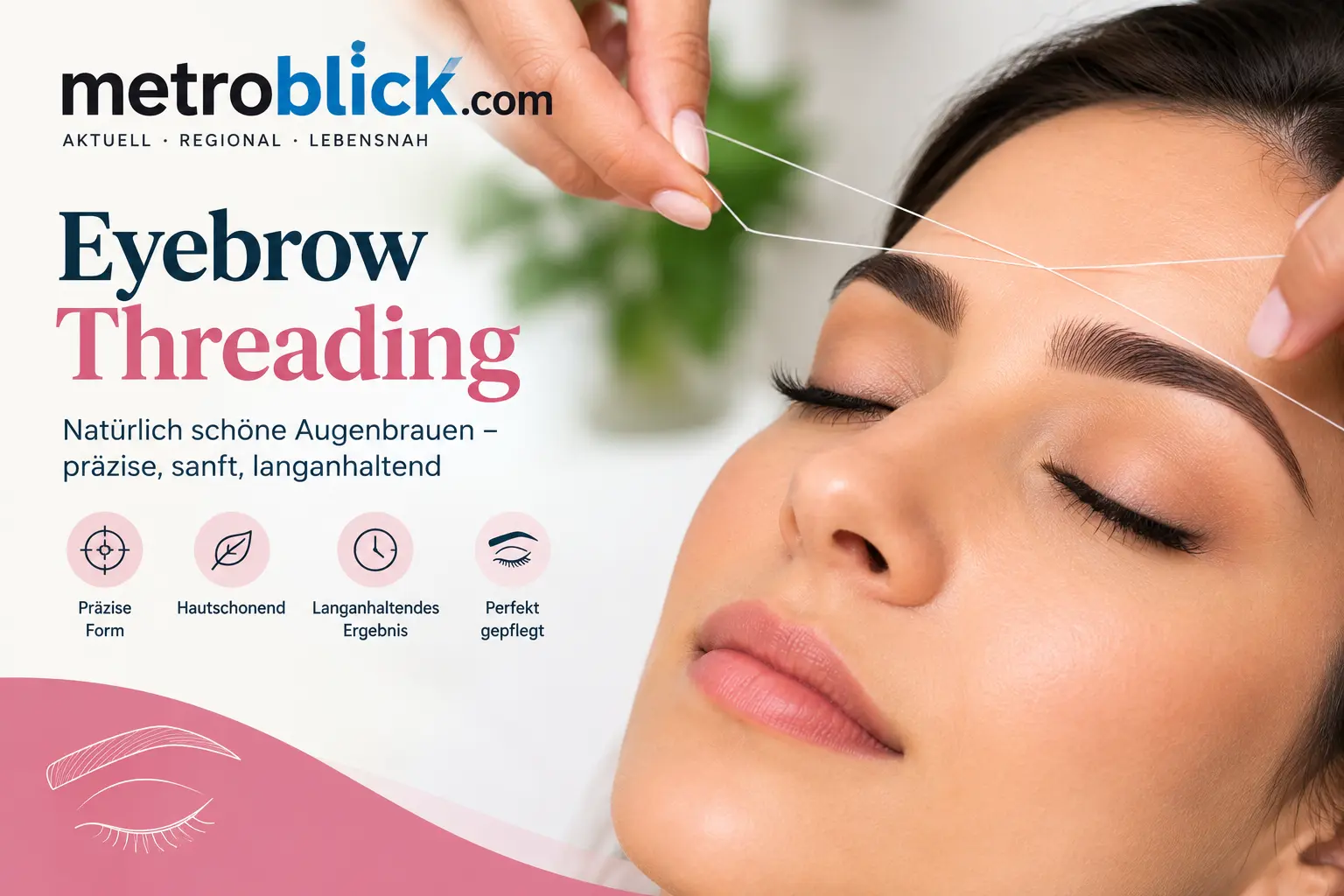
Eyebrow threading is a precise facial hair-removal and brow-shaping technique that uses a twisted strand of thread to remove unwanted hairs from the root. It has become popular because it can create clean, defined brows without applying wax or chemical hair-removal products directly to the skin.
For someone trying eyebrow threading for the first time, the process can raise several questions: Does it hurt? How long do the results last? Is it suitable for sensitive or acne-prone skin? How much does it cost, and what should you do before and after an appointment?
This complete guide explains eyebrow threading from A to Z, including the process, benefits, pricing, preparation, aftercare, brow shapes, skin considerations, comparisons with waxing and tweezing, salon selection, and practical tips for maintaining your brows.
What Is Eyebrow Threading?
Eyebrow threading is a hair-removal technique in which a thin thread, usually cotton, is twisted and manipulated to catch unwanted hairs and pull them out from the root. A trained technician can control the thread very precisely, making it possible to remove individual hairs or several hairs in a narrow line.
Unlike shaving, which cuts hair at the skin’s surface, threading removes the hair from the follicle. Unlike waxing, it does not require hot wax or strips to be placed on the skin.
The technique has a long history across South Asia and the Middle East and is now widely offered by beauty salons and brow specialists in many parts of the world.
It is particularly associated with eyebrow shaping because the technician can work around the natural brow line and remove small amounts of hair with considerable control.
How Does Eyebrow Threading Work?
The process is relatively simple, but achieving balanced brows requires practice and precision.
A typical appointment follows these steps:
- The brow area is inspected. The technician looks at the natural growth pattern, existing shape, density, and symmetry.
- The skin is prepared. The area may be gently cleansed to remove makeup, oil, or skincare residue.
- The thread is prepared. A clean strand is twisted and positioned between the technician’s fingers.
- Unwanted hairs are caught. The twisted section of thread traps hairs close to the skin.
- The hairs are removed. Controlled movements pull the hairs from the root.
- The shape is refined. The technician works around the top, bottom, and center of the brows to create the requested shape.
- The area is checked. Remaining stray hairs may be removed and the brows assessed for balance.
- Aftercare is provided. A soothing product may be applied if appropriate.
The quality of the result depends heavily on technique. Threading is not simply a matter of pulling hair out; the technician needs to understand brow proportions, facial symmetry, hair direction, and how much hair should remain.
Eyebrow Threading Benefits
One of the biggest advantages of this method is precision. A skilled technician can target individual hairs instead of removing a broad area of hair at once.
Other potential benefits include:
- Precise brow shaping
- Removal of hair from the root
- No wax required
- No chemical depilatory required
- Controlled removal around the brow line
- Quick treatment for many people
- Ability to preserve a natural-looking brow
- Useful for cleaning up small stray hairs
- Less direct product contact with the skin than waxing
Threading can also be useful when someone wants a specific arch or cleaner brow outline without dramatically reducing the overall thickness.
However, benefits vary from person to person. Threading is not automatically better for every skin type, hair type, or individual preference.
What to Expect During an Eyebrow Threading Appointment
A first appointment usually starts with a short discussion about the desired result.
You may be asked whether you want to keep your brows thick and natural, create a defined arch, clean up the edges, or make the brows look more symmetrical.
If you have a preferred shape, showing a reference photo can help communicate your expectations. However, the exact result should also take your natural brow growth and facial proportions into account.
During the treatment, you may feel repeated small pulls as hairs are removed. The technician may work in short sections rather than removing the entire brow at once.
The appointment itself is usually straightforward, but the experience can vary according to hair density, skin sensitivity, technician skill, and the amount of shaping required.
Afterward, the skin may look slightly red or feel warm or sensitive for a short period.
Does Eyebrow Threading Hurt?
It can be uncomfortable, but pain levels vary considerably.
People commonly describe the sensation as tiny pinches, pulling, tugging, or a quick stinging feeling. Because many hairs can be removed relatively quickly, some people find the experience easier than they expected. Others may find threading more uncomfortable, particularly around sensitive areas.
Cleveland Clinic notes that threading can cause temporary redness, irritation, swelling, or discomfort, while individual tolerance varies.
Your first appointment may feel more noticeable simply because you are unfamiliar with the sensation.
The technician’s technique also matters. A trained professional who controls the thread properly can make the process smoother and reduce unnecessary pulling of the skin.
How Long Does Eyebrow Threading Last?
Results do not last for exactly the same amount of time for everyone because hair growth differs from person to person.
Because the hair is removed from the root, results generally last longer than shaving, which only cuts hair at the skin’s surface. Many people schedule another appointment after several weeks when enough new growth becomes visible.
Cleveland Clinic reports that many people return for threading approximately every three to four weeks, although personal hair growth and preferred appearance determine the actual schedule.
Some people may notice regrowth sooner, while others can maintain their preferred shape for longer.
How Much Does Eyebrow Threading Cost?
The price depends heavily on location and the salon or technician providing the service.
Factors that can affect the price include:
- City or neighborhood
- Salon type
- Technician experience
- Brow shaping complexity
- Whether threading is offered as part of a package
- Additional services such as tinting
- Local demand
- Salon reputation
For example, current marketplace listings in Pakistan show threading prices varying substantially by area, with some listings ranging from a few hundred to more than a thousand Pakistani rupees.
Because prices change between businesses, checking the salon’s current service menu is more useful than relying on a single nationwide average.
What Factors Affect Eyebrow Threading Prices?
Two salons in the same city can charge different amounts for the same basic service.
A premium salon may charge more because of its location, staff experience, facilities, appointment system, or additional brow services.
The amount of work can also affect the price. Simple cleanup may cost less than a complete reshaping session.
Before booking, check whether the advertised price includes only basic threading or whether brow mapping, trimming, tinting, or other services cost extra.
Eyebrow Threading vs. Waxing
Threading and waxing both remove hair from the root, but they use very different techniques.
Threading uses twisted thread to capture hairs. Waxing applies wax to the skin and removes the hair when the wax is pulled away.
Threading can provide highly controlled hair removal around the eyebrow. Waxing can remove multiple hairs at once and may also remove some surface skin cells.
Waxing can cause temporary redness and irritation, and people using retinoid products need to take particular care because waxing can remove superficial layers of skin along with hair. The American Academy of Dermatology advises avoiding retinoid creams before facial waxing.
Which method works better depends on skin sensitivity, personal preference, desired brow shape, and the technician’s skill.
Eyebrow Threading vs. Tweezing
Tweezing removes hairs individually with a pair of tweezers. Threading can remove individual hairs or several hairs in a controlled movement.
Tweezing can be useful for maintaining a brow shape between professional appointments because it allows you to target one obvious stray hair.
Threading is generally more practical when several hairs need to be removed and the overall brow shape needs to be refined.
For detailed shaping, both methods can be precise. The main difference is speed and technique.
Threading, Waxing, and Tweezing: Key Differences
| Feature | Threading | Waxing | Tweezing |
|---|---|---|---|
| Hair removal | Thread catches hairs | Wax grips hairs | Tweezers grip individual hairs |
| Hair removed from root | Yes | Yes | Yes |
| Precision | High | Moderate to high | Very high for individual hairs |
| Product applied to skin | Thread only | Wax | None |
| Best use | Shaping and cleanup | Fast removal | Small maintenance jobs |
| Technique required | High | Moderate to high | Moderate |
| Skin reaction | Can cause temporary redness | Can cause redness and irritation | Can cause irritation if overused |
There is no single method that is ideal for every person. Skin condition, hair growth, desired shape, budget, and personal comfort all matter.
Is Eyebrow Threading Good for Sensitive Skin?
It can be suitable for some people with sensitive skin, but sensitive skin does not guarantee a reaction-free experience.
One reason people choose threading is that it does not require wax or a chemical depilatory to be spread across the brow area. This may be useful for someone who reacts to particular waxing products.
However, the physical process can still temporarily irritate the skin. Cleveland Clinic notes that people with sensitive skin can respond differently and recommends discussing individual tolerance with an experienced professional.
If your skin reacts easily, tell the technician before the appointment and avoid scheduling the treatment when your skin is already irritated, sunburned, peeling, or inflamed.
Eyebrow Threading and Acne-Prone Skin
People with acne-prone skin may prefer threading because it does not involve applying wax over the entire brow area.
However, acne-prone skin can still become temporarily irritated after hair removal. Touching the area with unclean hands, applying heavy products immediately afterward, or exposing freshly treated skin to potential irritants can make the situation worse.
If there are active, painful, open, or inflamed lesions directly where the thread will be used, consider postponing the appointment or asking a dermatologist or qualified professional for advice.
The goal is not simply to remove hair; it is to do so without unnecessarily disturbing an already compromised skin barrier.
How to Prepare for Eyebrow Threading
Good preparation can make the appointment more comfortable and help protect your skin.
Before your appointment:
- Arrive with reasonably clean skin.
- Remove heavy makeup around the brows.
- Tell the technician about sensitive skin or previous reactions.
- Explain the brow shape you want.
- Bring a reference photo if you have one.
- Avoid experimenting with new skincare products immediately before the appointment.
- Tell the technician if you use retinoids, retinol, acne treatments, or strong exfoliating products.
- Do not aggressively scrub the brow area before threading.
Most importantly, avoid making major changes to your brows immediately before your appointment. If you have already removed too many hairs yourself, the technician has fewer hairs available to work with.
Eyebrow Threading Aftercare
After hair removal, the skin around the brows can be temporarily more sensitive.
Simple aftercare includes:
- Keep the area clean.
- Avoid unnecessary touching.
- Use only gentle products that your skin already tolerates.
- Follow the technician’s specific aftercare instructions.
- Avoid immediately applying irritating skincare products.
- Protect the area from excessive sun exposure.
- Avoid activities that cause significant heat or irritation if your skin is reacting.
Cleveland Clinic recommends avoiding touching the area and taking precautions around potential sources of infection and irritation after threading.
What to Avoid After Eyebrow Threading
For the first part of the recovery period, avoid unnecessary irritation.
Depending on your skin’s sensitivity, this can include:
- Scratching or rubbing the brows
- Heavy makeup immediately after treatment
- Strong exfoliating acids
- Retinoids or retinol
- Excessive heat
- Swimming in poorly maintained water
- Picking at bumps or irritated areas
- Direct, prolonged sun exposure
You do not necessarily need to avoid every skincare product for the same amount of time. The right approach depends on the condition of your skin and the products you use.
How Long Does Redness Last After Threading?
Mild redness is common after facial hair removal because the skin has experienced repeated mechanical pulling.
For many people, the redness settles relatively quickly. Others may experience sensitivity for longer.
The important distinction is between temporary mild redness and symptoms that continue to worsen. Significant swelling, severe pain, spreading redness, pus, blistering, or other unusual symptoms deserve professional medical attention.
Do not repeatedly touch or scrub the area to try to make redness disappear faster.
How Often Should You Get Eyebrow Threading?
There is no universal schedule.
Many people book a new appointment every three to four weeks, while others wait longer depending on their hair-growth rate and preferred brow appearance.
If your brows still look clean and balanced, there is no need to remove hair simply because a certain number of days has passed.
The best schedule is the one that maintains your preferred shape without repeatedly over-removing hair.
Choosing the Right Eyebrow Shape
A good brow shape should work with your natural growth pattern rather than forcing every person into the same template.
Consider:
- Natural brow thickness
- Brow length
- Arch position
- Eye shape
- Facial proportions
- Hair density
- Personal style
Before removing hair, communicate whether you prefer a soft, natural appearance or a more defined arch.
A technician should generally work with the hairs you have instead of promising to create a completely different brow structure through excessive removal.
Eyebrow Threading for Thick Brows
Thick brows provide plenty of hair to work with, which can make reshaping easier.
The goal is not necessarily to make thick brows thin. Many people simply want excess growth cleaned up while retaining their natural fullness.
A technician can focus on:
- Cleaning the lower brow line
- Removing stray hairs between the brows
- Refining the upper outline
- Defining an arch
- Maintaining overall thickness
If you want fuller brows, tell the technician before the session so unnecessary hairs are not removed.
Eyebrow Threading for Thin or Sparse Brows
Thin or sparse brows require a more conservative approach.
Removing too many remaining hairs can make the brows look even thinner. Instead, the technician may focus on cleaning obvious stray hairs while preserving as much natural density as possible.
If your brows have gaps, brow makeup or cosmetic products can sometimes create the appearance of greater fullness without removing additional hair.
For significant or sudden eyebrow hair loss, however, cosmetic shaping is not the same as treating the underlying cause. A healthcare professional can help if hair loss is new, pronounced, or unexplained.
Eyebrow Threading for Natural-Looking Brows
A natural-looking brow does not have to mean an unmaintained brow.
The technician can remove stray hairs while keeping the natural thickness, texture, and general direction of growth.
If you want this style, explain that you prefer:
- Soft edges
- Moderate cleanup
- Preserved thickness
- A subtle arch
- No overly sharp outline
A reference photograph can make the desired level of shaping easier to communicate.
Eyebrow Threading for Arched Brows
An arched brow has a noticeable lift toward the outer portion of the eyebrow.
Creating an arch requires careful removal because taking away too much hair below or above the wrong section can change the expression of the face.
A professional should consider the natural location of your arch rather than creating an identical arch on every client.
If you want a more dramatic arch, discuss how much change is realistic before the treatment begins.
Stay updated with the latest insights, fresh stories, and amazing new articles where to learn gardening online.
Eyebrow Threading for Men
Brow grooming is not limited to women.
Men may choose threading to remove stray hairs, clean up the area between the brows, reduce an unibrow, or maintain a more polished appearance while keeping the brows masculine and natural.
A good approach is often subtle cleanup rather than excessive shaping.
If you prefer your brows to remain thick and natural, say so clearly before the service begins.
Eyebrow Threading Before and After
Before-and-after photographs can be useful when evaluating a brow technician, but they should be interpreted carefully.
Look for:
- Consistent lighting
- Similar camera angles
- Unedited images
- Different natural brow types
- Close-up views
- Clear examples of both subtle and defined shaping
Do not judge a salon only by one dramatic transformation. A skilled technician should be able to work with different brow densities and face shapes.
For a website, original before-and-after photography is also valuable visual content. Google’s September 2026 Search Console update now provides reporting for multimodal searches involving Google Lens, Circle to Search, image uploads, and other image-based discovery methods.
That makes high-quality, original visual content increasingly useful for a beauty topic like brow shaping.
Eyebrow Threading for Different Face Shapes
Face shape can help guide brow design, but it should not be treated as a rigid formula.
Round Face
A slightly more defined arch can create visual structure, depending on the person’s natural brow.
Oval Face
Many brow shapes can work well because the proportions are relatively balanced. A natural arch is often easy to maintain.
Long Face
A softer, less dramatic arch may help create a balanced appearance.
Square Face
A defined but not overly sharp brow can complement stronger facial angles.
Heart-Shaped Face
A softer, balanced brow can complement the forehead and chin proportions.
Diamond Face
A curved or softer brow may help balance prominent cheekbone structure.
These are general styling ideas, not strict rules. Your natural brow pattern should remain the starting point.
Can You Do Eyebrow Threading at Home?
It is possible to learn basic threading techniques, but shaping your own brows accurately is considerably harder than removing one or two stray hairs.
The main challenges include:
- Maintaining thread tension
- Controlling the direction of movement
- Seeing both brows clearly
- Maintaining symmetry
- Avoiding accidental over-removal
- Protecting delicate skin around the eyes
If you are inexperienced, professional threading is generally easier for a complete brow reshape.
For home maintenance, tweezing a few obvious stray hairs may be simpler than attempting a complete threading session on yourself.
Common Eyebrow Threading Mistakes to Avoid
Several mistakes can affect the final result.
Over-thinning the brows: Removing too much hair can take months of growth to correct.
Copying another person’s brow shape: A shape that works for one face may not suit another.
Threading irritated skin: Hair removal can make already inflamed skin more uncomfortable.
Ignoring skincare products: Retinoids and strong exfoliating products can make facial skin more vulnerable.
Choosing solely by price: An inexpensive appointment is not necessarily good value if the result requires months of regrowth.
Touching the area repeatedly afterward: Hands can transfer oil, dirt, and microorganisms to freshly treated skin.
Skipping the consultation: A short conversation before treatment can prevent misunderstandings about thickness and shape.
How to Choose an Eyebrow Threading Salon
Look for a salon or technician with evidence of consistent, professional work.
Useful things to check include:
- Recent customer reviews
- Real before-and-after photographs
- Clear service descriptions
- Current pricing
- Clean working practices
- Experienced technicians
- Convenient appointment options
- Clear communication
- A portfolio showing different brow shapes
Pay particular attention to reviews that describe the actual brow-shaping experience rather than reviews that only praise the salon’s atmosphere.
If possible, choose a technician who understands your desired style and does not immediately recommend removing large amounts of hair.
How to Find Eyebrow Threading Near Me
A local search should go beyond choosing the first salon that appears.
Compare nearby options based on:
- Distance
- Current opening hours
- Recent reviews
- Service prices
- Photos
- Booking availability
- Technician experience
- Exact services offered
Google’s local search guidance emphasizes factors such as relevance, distance, and prominence when determining local results. Keeping business information accurate and complete, maintaining a Business Profile, and providing useful photos and reviews can help customers evaluate a local business.
If you are searching on a phone, include the neighborhood or landmark when needed. A query such as “brow threading near downtown” can be more useful than a broad city-level search.
What to Check Before Booking a Threading Appointment
Before confirming an appointment, check:
- Exact service price
- Whether brow shaping is included
- Appointment duration
- Salon location
- Cancellation policy
- Available booking times
- Technician reviews
- Before-and-after examples
- Hygiene practices
- Whether you need to disclose skincare treatments
If you use prescription acne medication, retinoids, or other treatments that affect your skin, mention them before the appointment rather than waiting until the procedure begins.
Eyebrow Threading for Special Occasions
A brow appointment before a wedding, photo session, graduation, interview, party, or other important event can help create a polished appearance.
However, trying a new salon immediately before an important event is not ideal.
Your skin may react differently than expected, and a new technician may interpret your desired shape differently from what you imagined.
If the event is important, give yourself enough time to see how your skin responds and how the final shape looks before the big day.
How Soon Before an Event Should You Get Your Brows Threaded?
The ideal timing depends on how quickly your skin settles after hair removal.
If you already know that your skin tolerates threading well, scheduling the appointment a few days before an event may work for you.
If you are trying threading for the first time, it is better not to make your first-ever appointment immediately before a major event.
The same principle applies to a new brow shape: test significant changes before an important occasion rather than making the first attempt on the day before.
Eyebrow Threading and Skincare Products
Skincare deserves special attention because facial hair removal and active ingredients can interact in ways that increase irritation.
Products that may require extra caution include:
- Retinol
- Prescription retinoids
- Exfoliating acids
- Strong acne treatments
- Benzoyl peroxide
- Other products that leave the skin dry, peeling, or unusually sensitive
Tell your technician what you use rather than assuming a product is harmless.
The condition of your skin matters just as much as the product itself. If your brow area is peeling, raw, sunburned, or unusually irritated, postponing the appointment may be sensible.
Can You Get Eyebrow Threading While Using Retinol?
Extra caution is important when using retinol or prescription retinoids.
Cleveland Clinic’s dermatology guidance recommends avoiding retinoid and retinol-based products for five to seven days before threading because these products can increase skin sensitivity and the risk of peeling or bleeding during hair removal.
The exact recommendation can vary depending on the product, strength, frequency of use, and your skin.
If you use a prescription retinoid, ask the prescribing clinician or dermatologist about the appropriate pause before facial hair removal rather than changing your medication schedule on your own.
This is especially important because retinoid-related sensitivity can make mechanical hair removal more irritating.
Eyebrow Threading Hygiene and Safety
Hygiene is an essential part of facial hair removal.
A reputable technician should use clean materials and maintain appropriate hand and surface hygiene. Fresh thread should be used for each client rather than reusing thread that has contacted another person’s skin.
The surrounding area should also be handled carefully because the skin can be temporarily more vulnerable after hair removal.
Cleveland Clinic specifically highlights the importance of experienced practitioners and sanitary practices, including clean thread and appropriate hand hygiene.
If a salon appears unhygienic, uses visibly contaminated materials, or cannot explain its basic sanitation practices, consider choosing another provider.
When Should You Avoid Eyebrow Threading?
Consider postponing treatment if the skin around the brows is:
- Sunburned
- Open or broken
- Severely irritated
- Peeling
- Actively inflamed
- Experiencing an unexplained rash
- Healing from a recent procedure
Extra caution may also be necessary if you use medications or skincare products that increase skin sensitivity.
If you have a significant skin condition, recent cosmetic procedure, or prescription treatment affecting the brow area, ask an appropriate healthcare professional before proceeding.
The aim is not simply to achieve a clean brow. Healthy skin should remain the priority.
How to Maintain Your Eyebrow Shape Between Appointments
Good maintenance does not require constantly removing new hair.
Between appointments:
- Avoid repeatedly reshaping the brows.
- Use clean tweezers for an occasional obvious stray hair if you are comfortable doing so.
- Follow the original brow outline rather than creating a new one each time.
- Avoid removing hairs from areas that appear sparse.
- Take occasional photos to compare your natural shape.
- Wait for enough regrowth before booking another full shaping session.
If you are trying to grow over-plucked brows, patience is often more useful than repeated correction.
FAQs
What is eyebrow threading?
It is a facial hair-removal technique that uses twisted thread to catch and remove unwanted hairs from the root, particularly around the eyebrows.
How does eyebrow threading work?
A technician twists a clean strand of thread and uses controlled movements to trap and remove unwanted hairs. The process allows precise shaping around the natural brow line.
Does eyebrow threading hurt?
It can cause temporary discomfort, usually described as pulling, pinching, or brief stinging. Sensitivity varies between individuals.
How long do the results last?
Results commonly last for several weeks, depending on individual hair growth. Many people schedule maintenance appointments around every three to four weeks.
How much does eyebrow threading cost?
Prices vary by location, salon, technician, and included services. Local listings can differ considerably, so checking the current price directly with the salon is the most reliable approach.
Is threading better than waxing?
Neither method is universally better. Threading offers precise hair removal without wax, while waxing can remove multiple hairs quickly. Skin sensitivity and personal preference should be considered.
Is threading suitable for sensitive skin?
It can work for some people with sensitive skin, but it can still cause temporary redness or irritation. An experienced technician and appropriate preparation are important.
Can I get my brows threaded if I have acne?
It depends on the location and condition of the acne. Avoid threading directly over open, painful, or severely inflamed lesions and ask a healthcare professional when unsure.
Can I use retinol before threading?
Retinol and prescription retinoids can increase skin sensitivity. Cleveland Clinic advises avoiding retinoid and retinol products for five to seven days before threading, while individual medical advice may differ.
What should I avoid after threading?
Avoid unnecessary touching, rubbing, strong skincare actives, excessive heat, and other activities that noticeably irritate freshly treated skin.
How often should I get my brows threaded?
Many people return every three to four weeks, but the right interval depends on hair growth and the appearance you want to maintain.
Can men get their brows threaded?
Yes. Men can use threading to remove stray hairs, clean up the area between the brows, or maintain a neat but natural brow shape.
Can I thread my brows at home?
It is possible, but creating a symmetrical shape requires practice and good control. Professional threading is generally easier for a complete reshaping.
How long does redness last after threading?
Mild redness often settles relatively quickly, but the duration varies with skin sensitivity and the treatment. Persistent or worsening symptoms should be evaluated professionally.
How should I choose a threading salon?
Check recent reviews, real photographs, pricing, technician experience, hygiene practices, location, and whether the technician understands the brow shape you want.
Where can I find a threading salon near me?
Use local search to compare nearby businesses, then check their current reviews, hours, prices, photographs, services, and booking availability before choosing one.
Conclusion
Eyebrow threading is a precise way to remove unwanted facial hair while refining the shape and appearance of the brows. Its biggest practical advantage is control: a skilled technician can target individual hairs and gradually create a clean outline without applying wax across the brow area.
The best results depend on more than the technique itself. Your natural brow density, face shape, desired appearance, skin sensitivity, skincare routine, and technician’s experience all play a role.
Before an appointment, communicate the shape you want and disclose products or medications that may affect your skin. Afterward, keep the area clean, avoid unnecessary irritation, and give your skin time to settle.
Whether you want subtle cleanup, fuller natural brows, a defined arch, or regular maintenance, choosing an experienced professional and protecting the skin around the brows are the two most important parts of getting a consistent result.
Stay updated with the latest insights, fresh stories, and amazing new articles how to stop snoring.